

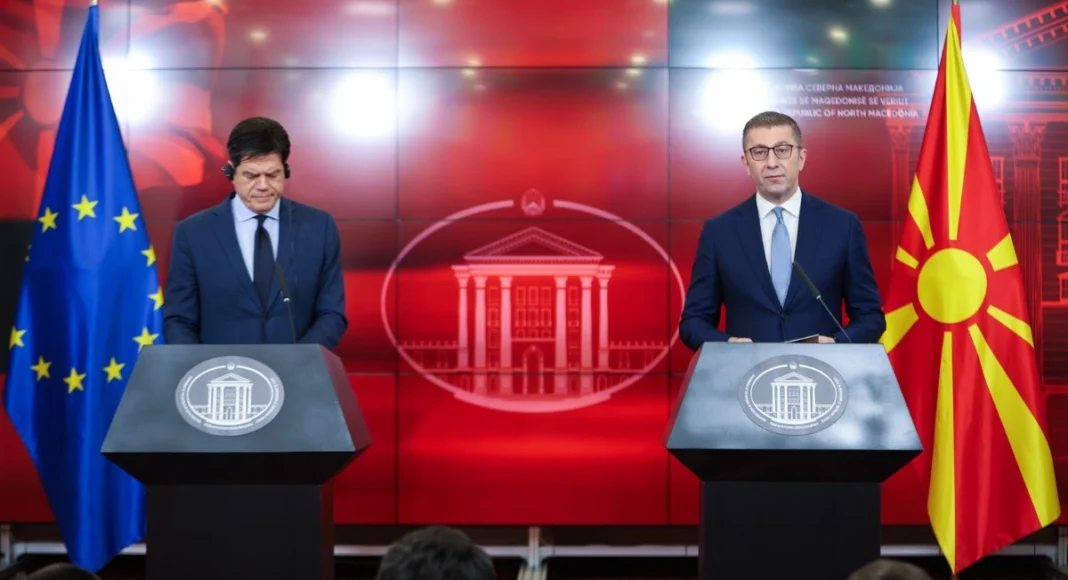

Macedonian Prime Minister HristijanMickoski assessed on Thursday that the European Commission’s 2026 Progress Report on North Macedonia is better than the one in 2025, noting that it does not contain a single assessment of regression, while two negotiating chapters show an increased level of preparation for membership in the European Union.
At a joint press conference with the European Union’s Ambassador to the country MichalisRokas, who handed over the Report to the Prime Minister, Mickoski said the European Commission has noted progress in the implementation of the Reform Agenda and included the country among those with the best results as part of the Reform and Growth Facility.
“We have a better report than last year. The European Commission notes significant progress in the implementation of our Reform Agenda and counts us among the countries with the best results within the European Reform and Growth Facility. This year’s report does not contain a single assessment of regression. On the contrary, in two negotiating chapters the level of preparation for membership in the European Union has increased, i.e., in digital transformation and media, as well as in education and culture. Such improvement last year was recorded in only one chapter,” Mickoski said.
The PM said the assessments are backed up with concrete results, adding that by June 2026, the European Commission has released EUR 142.1 million as part of the Reform Agenda.
Mickoski also touched upon the economic indicators highlighted in the Report, which he said confirm economic growth of 3.5 percent in 2025, as well as reduction of unemployment from 12.5 to 11.7 percent. At the same time, he stressed that the Report covers the period until August 31, 2026, and in the meantime the International Monetary Fund and the World Bank have revised economic growth projections upwards.
The Prime Minister pointed out that the European Commission has noted good progress in digital transformation, science, and research, as well as in foreign and defense policy.
In terms of the judiciary, Mickoski highlighted that the European Commission has said the new Law on Judicial Council has largely addressed the recommendations of the Venice Commission.
Mickoski drew a comparison with the 2025 Progress Report which noted no progress in Chapter 23 – Judiciary and fundamental rights, while the 2026 Progress Report notes limited progress. He also highlighted the change in assessment from ‘no progress’ to ‘some progress’ in terms of the functioning of the judiciary. This is a shift that should continue to be affirmed with results in practice, the Prime Minister added.
Regarding European integration, the Prime Minister reiterated that Macedonia remains committed to full EU membership, but stressed that the process must be based on clear rules, predictability, and mutual trust.
He noted that the issue of constitutional amendments remains open, assessing that the country does not lack reforms, but rather faces outstanding political conditions. We are not asking for privileges. We are asking for the consistent application of the principle that progress should be evaluated based on achieved results, PM Mickoskiunderscored.