

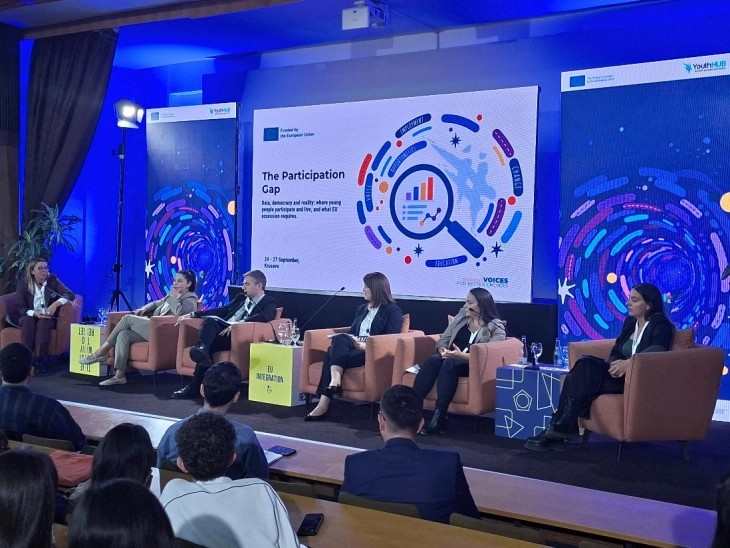

Around 120 young people from 15 Southeast European countries are participating in the 24th International Youth Conference, held in Kruševo until tomorrow under the motto “Europe Starts Here and Now – Youth, European Values, and Enlargement as Our Shared Future.”
Metodija Stojcheski, executive director of the Krushevo Youth Alliance, the organization that has hosted this international youth conference for 24 years, believes that young people must be motivated to return to the country and become part of progressive economic processes.
“We need to open up the labor market to allow for the free movement of people, so that it is not just a case of our people leaving, but also of them returning and investing their knowledge and capital in their own country. We also need to create opportunities for young people to participate in decision-making processes within their country, thereby articulating their needs and helping to shape the attitudes necessary for building prosperous societies,” said Stojcheski.
Almost all the young participants agree that corruption and the lack of youth involvement in addressing societal issues are driving emigration and migration. These are the main problems facing young people in Southeast Europe. The pressure is particularly acute for youth in the six Western Balkan countries awaiting accession to the European Union.
“The system in Bosnia and Herzegovina leaves considerable room for corruption, various forms of malfeasance, and nepotism. However, young people are quite active; we are working to reduce and virtually eliminate this ‘cancer’ within society,” noted Adem Ajdin from Bosnia and Herzegovina.
Kreshnik Nikola Kadiu from Albania agrees regarding the level of corruption and believes that the voices of young people are barely heard, except every four years during elections.
“As young people, we need to be good citizens—not just citizens who vote every four years. Before our voices can be heard loud and clear, we need to discuss the problems and how to solve them, so that there is actually something to be heard,” said Kadiu.
Nina Jovanovska from the Krushevo Youth Alliance emphasizes that, even after six years, the Law on Youth is not being implemented in Macedonia, effectively leaving young people on the margins.
“Municipalities rarely allocate a specific budget, such as 0.1 percent, for youth. Very few municipalities open up the processes for establishing youth councils, and even when they are created, their competencies and responsibilities are not clearly defined. All of this dilutes the process, failing to reach the core objective: ensuring young people are genuinely part of these processes,” said Jovanovska.
The conference is held as part of the Western Balkans Youth Lab (WBYL) project, implemented by the Regional Cooperation Council (RCC) and funded by the European Union.