

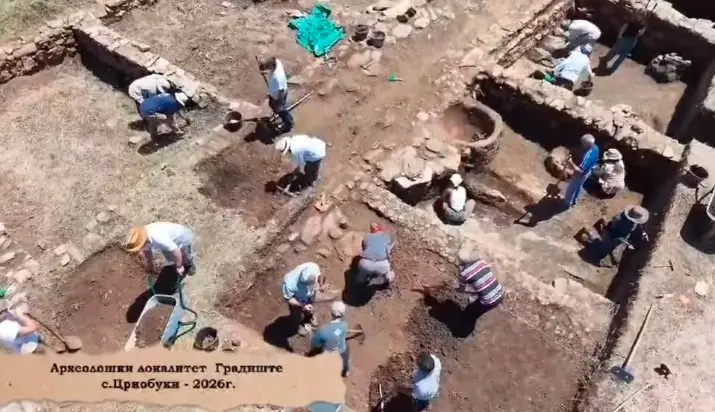

Macedonian and US archaeologists, professionals from the National Institute of Archaeology and Museum-Bitola and Cal Poly Humboldt University in Arcata, California, continued last year’s research at the Gradishte archaeological site, near the village of Crnobuki in Bitola.
“Let’s discover the past to better build the future. We, as worthy heirs, are discovering the story of our ancestors,” said the team that is working intensively at the Gradishte archaeological site these days.
“This year, the archaeological site of Gradishte near the village of Crnobuki has given us its gifts. The multitude of movable and immovable archaeological finds have once again enriched our knowledge of this ancient Macedonian city. Every coin found, every vessel found, every metal object found, they all tell us the story of Gradishte near Crnobuki, about the life of the common man, about the campaigns of the great generals, about the trade relations with the surrounding large cities of Thessaloniki, Pella, Amphipolis, Dyrachion. We are discovering the story of our ancestors as worthy heirs. We want to discover the past in order to better build the future,” said Engin Nasuh, project manager, advisor curator archaeologist at the National Institute and Museum of Bitola.
The archaeological site of Gradishte is located 12 kilometers from Bitola, a city from ancient times, a city that existed during the time of the Macedonian state and later in the Roman period. A Macedonian-US team of archaeologists last year at the Gradishte-Crnobuki site also discovered a layer from the late Eneolithic or early Bronze Age, as well as a fragmented female figurine. Archaeologists are using special equipment and technology, which has yielded findings that are older than the time of Philip V, and may be the city of Lynx, the capital of Lyncestis.