

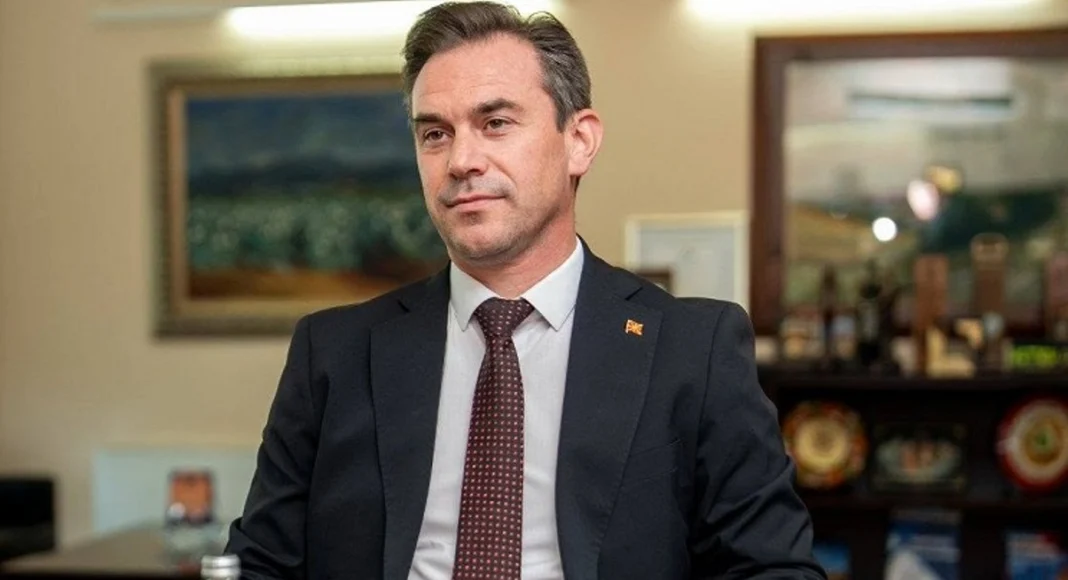

Impossible quantities of tobacco, unrealistic quantities of milk, renting agricultural land, are just some of the abuses that are being done to obtain subsidies, reveals Macedonian Minister of Agriculture, Forestry and Water Management Borche Serafimovski in an interview with MIA.
“About fifty applicants, mostly from the Prilep region and Krivogashtani, reported production of 10 and 11 tons of tobacco on two or 2.5 decares. That is impossible. What is happening with sheep and cows? There is a classic abuse of ear tags that mark each head. The head dies, and the owners simply take the tag, keep it, and still report the animal based on that tag even though it has already died. In an unofficial action that we have just conducted, it turned out that on paper we have almost 400,000 sheep, and in reality there are around 250 to 280,000. This is a difference of 100 to 130-140,000 heads. That is serious money if we take into account what financial support the owners receive per sheep – from breeding, milk, etc. Now, with the Food and Veterinary Agency (FVA), we are considering having each head have a chip that will be able to “It can be read with a regular reader. We will even be able to track the animals with GPS locators if we get to that point,” the minister said.
Serafimovski believes that this situation can only be overcome with increased controls, but he also appeals to farmers to be as responsible as possible and report real production.
“One decare of tobacco can produce 400 to 600 kilograms of tobacco, we are talking about some maximum yields. So, on two decares there is a ton and 200. You cannot declare 10 tons of tobacco. Why is that done? Some abuse it, others take areas from third parties and cultivate those same areas, and the original person who is the user of the area, whether it is private or a concession, takes the subsidies. And now here we are trying through the Inspectorate and the controls of the Financial Support Agency to discover and stop those irregularities. And the subsidies do not go directly to the farmer who produces, but go to someone who took, hypothetically, 100 hectares of area, does not work it, will give it to a third party to cultivate it. And now this person has an interest because he wants to work, and was unable to take it for various reasons – he did not meet the conditions, he did not have bank guarantees (because those areas must be guaranteed). Here there is a classic abuse of subsidies,” Minister Serafimovski noted.