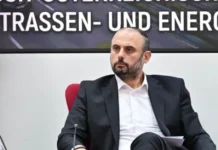
First, it is crucial to emphasize: these amendments do not change the basic model of public-private partnership, nor do they violate transparency and public control. On the contrary, they represent a limited and precise improvement of the existing system with the aim of greater efficiency, greater openness to innovation and better use of private expertise – but under full institutional control of the state, VMRO-DPMNE MP Bojan Stojanoski said Sunday while discussing the provisions envisaged in the new amendments to the Law on Concessions and Public-Private Partnership forwarded by a group of MPs.
Stojanoski explained that the proposed amendments introduce the possibility for the private sector to submit unsolicited proposals for public-private partnerships. This means that individuals or legal entities will be able to propose projects based on new technologies, concepts or infrastructure solutions of public interest.
“However, this does not mean a change in the decision-making system. The state remains the only entity that decides whether there is a public interest, whether the proposal will be accepted or whether a procedure for implementation will be opened at all,” said the VMRO-DPMNE MP.
According to Stojanoski, the amendments envisage that a private entity can submit an unsolicited proposal, but the public partner reviews and analyzes the proposal and then decides whether a procedure will be opened.
“The key thing is – there are no privileges. This is the most important element, the initiator: he does not receive an automatic right to a contract, he does not receive a guarantee of winning the public procurement, he does not receive a direct concession.
Is there any privilege for the initiator? No. The only thing envisaged is a limited mechanism that refers to: the possibility of reimbursement of costs in strictly defined cases or the possibility of bid matching, and only if the initiator participates in the procedure and if his bid is competitive. If he does not participate or does not win, there is an obligation to reimburse actual documented costs in precisely defined situations, but without any right to a contract,” claims Stojanoski.
The ruling party representative says that the essence of the submitted changes is to make the system more functional, i.e. to enable faster identification of potential infrastructure projects, greater access to innovations from the private sector, as well as better use of expertise and technological solutions, as well as reducing administrative inertia and more efficient preparation of public projects.