

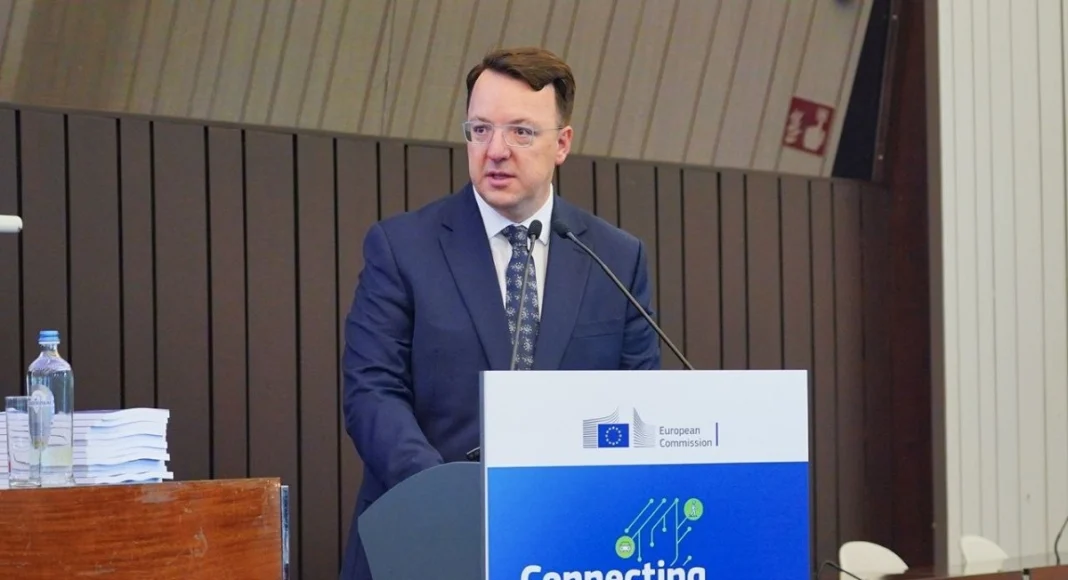

As a landlocked Balkan country, we are making major investments in the development and modernization of European Corridors VIII and X. We are building motorways on Corridor VIII and a railway on its eastern section, while construction of a high-speed railway on Corridor X has also begun. We are also working on introducing intelligent transport systems on the road section and together with our neighbors, we are also working to expand border crossings, Macedonian Deputy Prime Minister AleksandarNikoloski said in his address to the Connecting Europe Days event in Brussels.
“Regarding the eastern section of Corridor VIII, we are investing in both motorways and the railway. We have completed the first highway section, and we expect work on the second section to begin next year in partnership with the European Union and the European Investment Bank, acting as the lead financial institution, and I would like to express my gratitude for this excellent cooperation. As for the railway, it comprises three sections: we have finished the first, the second is currently under construction and scheduled for completion by the end of 2028, and last week, again in collaboration with the EIB, we launched the procurement process to select a contractor for the third section, which is the most challenging phase of the railway corridor. Although it spans only 23.1 kilometers, 75% of the route consists of major structures, including over 20 tunnels and 56 bridges, illustrating the project’s complexity. The route passes behind a border town and connects to the joint tunnel we will be building together with Bulgaria,” said Nikoloski.
He highlights that this is one of the few pieces of positive news regarding Macedonia’s current relations with Bulgaria, noting that a joint intergovernmental agreement was signed last November for the construction of this cross-border tunnel, which is intended to open up the entire Corridor VIII. If everything goes according to plan, Nikoloski estimates that within five years of the contractor’s selection, by 2031–2032, there should be a complete railway connection linking Skopje, Sofia, Burgas, Varna, and Odessa.