

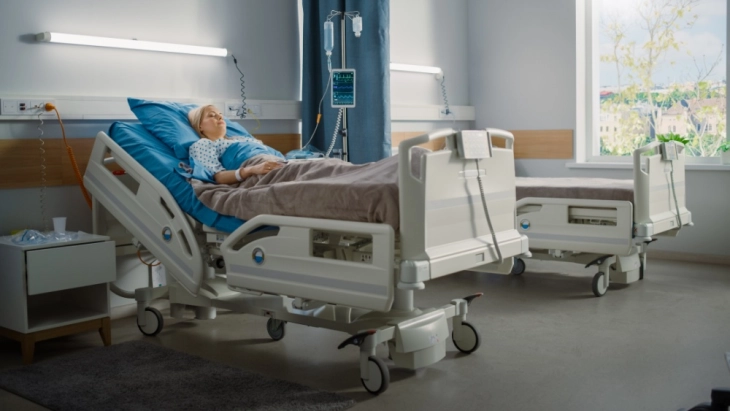

There were 507 hospital beds per 100,000 people in the European Union in 2024, a slight drop from 511 registered in 2023, according to Eurostat data.
The trend of decreasing number of hospital beds began in 2009 (582 hospital beds per 100,000 people), as a result of the impact of scientific and technological developments that have shortened the average length of stay for many hospital procedures or replaced them with outpatient or day treatment.
Among EU countries, Bulgaria has the highest number of hospital beds per 100,000 inhabitants – 870, followed by Germany with 759, Romania with 731, Austria with 655 and the Czech Republic with 639.
In contrast, six EU countries have fewer than 300 hospital beds per 100,000 people: Sweden (187), the Netherlands (221), Denmark (226), Finland (248), Spain (283) and Ireland (293).
In terms of beds in long-term care facilities, the Netherlands (1,390), Sweden (1,298) and Belgium (1,249) have the most.
Greece with 20 and Bulgaria with 26 long-term care beds per 100,000 people are at the bottom of the list of EU countries.
The latest available Eurostat data for Macedonia is for 2021, and it shows that we had 449 hospital beds per 100,000 inhabitants, and 51 for long-term care. According to the number of hospital beds, Macedonia is ahead of 14 EU member states.